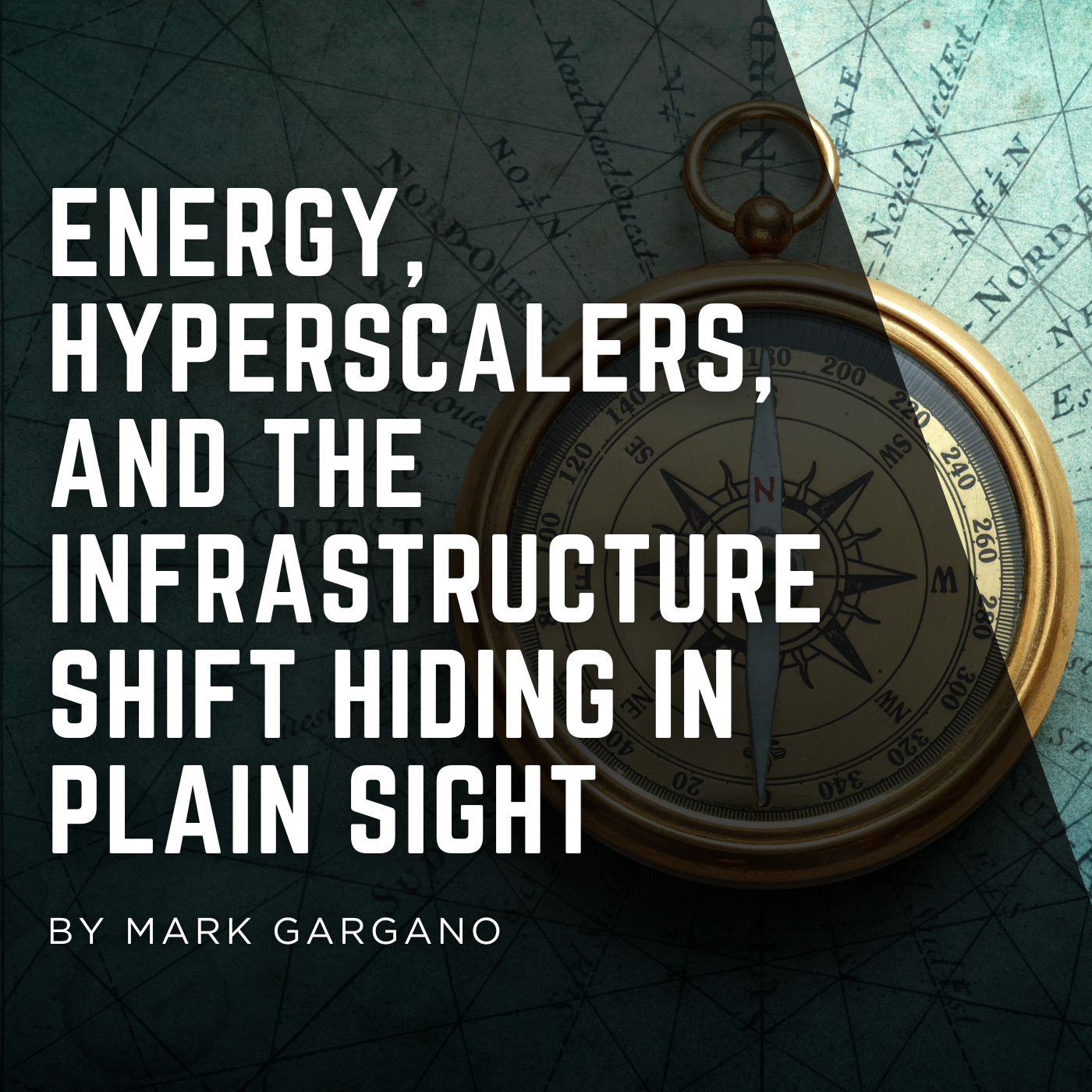
Energy, Hyperscalers, and the Infrastructure Shift Hiding in Plain Sight

March 13, 2026

Issue # 7

Taxes Don't Have to Be Confusing

Energy, Hyperscalers, and the Infrastructure Shift Hiding in Plain Sight


I’ve always been fascinated by energy and power. Maybe it’s because it sits underneath everything. We don’t think about it much — until we need it. Flip a switch. Charge a car. Run a data center. It’s invisible… until it isn’t.


Lately, I’ve found myself drawn to what’s happening at the intersection of hyperscalers, capital spending, and the power grid. Whether this space is your thing or not, the scale of what’s happening is hard to ignore.


According to research from Apollo Global Management (February 2026), hyperscaler capital expenditures are expected to reach roughly $646 billion in 2026 — nearly 2% of U.S. GDP. That’s comparable to the GDP of countries like Singapore or Sweden. It’s roughly in line with total U.S. bank loan growth. It’s larger than the combined military spending of several developed nations.

That’s not incremental change. That’s structural.


And that capital isn’t going into abstract ideas. It’s going into CPUs, GPUs, networking equipment, storage arrays, steel buildings, cooling systems, and transmission lines. The hyperscalers — Amazon, Microsoft, Google, Meta, and increasingly Oracle — are not just software companies anymore. They are infrastructure companies.


Utilities: From Defensive to Relevant Again


For most of my investing life, I’ve thought of utilities as the place you go to hide out. Stable earnings. Regulated returns. Dividends. Not exciting. Just steady.


But steady becomes strategic when demand shifts.


Data centers require enormous amounts of reliable power — and not just occasionally. They need it 24/7. As AI workloads scale, electricity demand is rising in ways we haven’t seen in years.


Utilities are responding through capital investment: transmission buildouts, generation expansion, renewable integration, natural gas plants, and even renewed conversations around nuclear power if it can be deployed safely.


Higher demand can mean larger capital plans, expanding rate base (if approved), and potentially steady earnings growth — not explosive, but durable.


I Don’t Need to Be the Hero


As an investor, I’m not trying to forecast every load curve or pick the next GPU winner. That’s not my unique ability.

I operate with a 'Who, not How' mindset. I’d rather work with managers who study credit metrics, rate base growth, capex plans, and regulatory filings every single day — while I focus on the strategic planning work that energizes me.


If you own the S&P 500, you already own significant exposure to hyperscalers. Technology can represent 30–40% of the index depending on classification. Utilities, by contrast, are a small slice.


For me, adding utilities isn’t about chasing returns. It’s about balance. It’s about participating in infrastructure growth without concentrating further in tech.


The Grid Is the Real Story


The AI revolution isn’t just code. It’s copper. It’s steel. It’s substations and turbines. It’s balance sheets expanding to fund transmission and generation.


We are witnessing one of the largest private capital deployment waves in modern history — and it all depends on electricity.

This doesn’t mean putting all your eggs in one basket. It means recognizing how deeply physical this transformation really is.

I don’t need to be the hero in this story. I just need to understand the direction of change, stay diversified, and partner with the right people who monitor the details.


Power may not be flashy. But it may be one of the most important investment backdrops of the next decade.

Research Sources Referenced


• Apollo Global Management, 'Putting the total amount of hyperscaler capex into perspective' (February 2026)

• U.S. Department of Energy reports on data center electricity demand

• U.S. Energy Information Administration electricity demand outlook

• Public investor presentations from major electric utilities


Additional Research and Credit Framework References


To provide broader context and reduce bias, the following external research sources and frameworks inform the financial and infrastructure analysis discussed in this article:


Credit Metrics & Leverage: What Rating Agencies Actually Evaluate


• S&P Global Ratings – 'Key Credit Factors for the Regulated Utilities Industry' (methodology criteria).

• S&P commentary discussing FFO-to-debt thresholds and downgrade triggers in practice.

• Additional S&P regulatory write-ups referencing FFO/debt and interest coverage expectations.

• Moody’s published rating methodology directory for regulated utilities.

• Moody’s credit opinion examples (including Florida Power & Light) discussing capex, rate base growth, and cash flow framing.

• Regulatory filings defining FFO/CFO pre-working capital consistent with Moody’s methodology usage.

• Connecticut Office of Consumer Counsel (OCC) credit rating FAQ explaining FFO-to-debt in plain English.


How this maps to metrics: While Debt/EBITDA is commonly referenced, rating agencies place significant weight on FFO-to-debt ratios and interest coverage when assessing utility credit risk and capital structure resilience.


Data Centers & AI Load Growth: Demand Shock Implications


• U.S. Department of Energy (Dec 2024) report on data center electricity demand.

• U.S. Energy Information Administration (Jun 2025) computing electricity use projections.

• EIA Short-Term Energy Outlook (May 2025) documenting rising U.S. electricity consumption.

• Pew Research (Oct 2025) overview of data center energy use trends.


How this maps to metrics: Higher electricity load growth may justify larger capital expenditure plans, which increases rate base (subject to regulatory approval), potentially supporting EPS growth. However, interconnection queues, transformer constraints, and grid modernization needs create both opportunity and risk.


Public Filings & Investor Materials Used for Analysis Framework


• American Electric Power (AEP) earnings presentations (Feb 2026) outlining transmission rate base growth.

• AEP investor relations releases confirming long-term EPS growth and capital allocation plans.

• Duke Energy investor relations materials (Feb 2026).

• NextEra Energy investor presentations (2025) detailing capex, EPS guidance, and dividend policy.


Thank You For Reading


If you are a family or business owner reading this, consider three reflections:


Where am I spending time that doesn’t require my unique ability?

Where is money sitting without strategic direction?

Which relationships deserve more intentional investment?


The answers to those questions often reveal the path forward.

True wealth is not simply accumulation.


It is alignment.


Time aligned with purpose.

Money aligned with strategy.

Relationships aligned with growth.


And when those are working together, 10x is no longer about scale alone — it is about significance.


Mark Anthony

Capital Compass and Key


Disclosure:

Investment advice offered through National Wealth Management Group, LLC, an SEC-Registered Investment Adviser.

All performance referenced is historical and is no guarantee of future results. All indices are unmanaged and may not be invested into directly.


The information presented is for educational and informational purposes only and is not intended as a recommendation or specific advice.


Additional Disclosure:

This material does not consider any investor’s specific objectives, financial situation, or particular needs and should not be construed as personalized advice. All investments involve risk, including the potential loss of principal. Strategies discussed may not be suitable for all investors and may change based on market, tax, or regulatory developments.

Before acting on any information contained herein, individuals should consult with a qualified financial, legal, or tax professional who can assess their unique circumstances.

February 25, 2026
Complicated doesn’t mean smart. Learn to cut through the tax noise and leverage your CPA to protect your wealth, manage surcharges, and plan for a successful exit.
January 5, 2026
If you’ve invested over the last 10–15 years, there’s a good chance things worked out reasonably well. Markets recovered quickly from setbacks, innovation continued, and policy, both fiscal and monetary, was generally geared toward stabilizing growth when things got uncomfortable. Most people are happy with that outcome. I am too. But the real question isn’t whether the last decade was “ good. ” It’s whether the next one will look the same, and what you should do if it doesn’t. One thing that has quietly changed is the cost of servicing government debt. Interest on the national debt has grown into a meaningful line item in the federal budget. Whether you call it 13%, 14%, or something in that neighborhood, the takeaway is simple: interest is competing with everything else the government spends money on. That doesn’t mean a crisis is imminent. It does mean the system has less flexibility than it did when borrowing costs were close to zero. Historically, when governments face this kind of math, there are only a few levers they can pull: · raise revenue · slow the growth of spending · grow the economy faster · allow inflation and financial conditions to quietly do some of the work Usually, it’s some combination of all four. You don’t need to predict which lever gets pulled first. It is, however, reasonable to acknowledge that taxes are historically low, and over time the pressure for them to move higher is more likely than lower. So what does this mean for you? This isn’t about panic. It’s about positioning. Many investors spend a lot of energy trying to guess the next winning asset class. A more useful question is: what would make your plan more resilient if the rules slowly change? One place to start is taxes. Many families have done an excellent job saving, but most of that savings sits in pre‑tax retirement accounts. That works beautifully when tax rates are stable or falling. If taxes rise in the future, however, those accounts concentrate risk in one place: future tax policy. That’s why more people are thinking about tax diversification, not just investment diversification. Practical questions worth considering include: · Do you have money spread across taxable, tax‑deferred, and tax‑free accounts? · Are Roth conversions worth exploring selectively over time? · Are conversions being coordinated with your CPA to avoid unintentionally pushing income into higher brackets? This is not about converting everything. It’s about creating options. Bonds are another area where old assumptions deserve a second look. For most of my career, short‑term Treasuries and government bonds were the default way to reduce risk. They still have a role. But today it’s fair to ask what “safe” really means if after‑tax returns barely keep up with inflation. Are you protecting your account balance, or your purchasing power? Bonds can reduce volatility. They don’t always protect lifestyle. Diversification still matters, but it’s important to be honest about what it can and cannot do. You’ll hear more discussion around international investing, mid‑cap stocks, dividend strategies, and private credit or private equity. Each of these can help diversify what drives returns. None of them eliminates risk. Moving away from where “everyone else” is invested can make sense, but only if it fits your plan—not because it sounds different or sophisticated. The goal isn’t to avoid downturns. The goal is to get through them without changing course at the wrong time. If you own a business, this conversation matters even more. Business ownership is often the largest asset on your balance sheet and the least liquid. A good plan forces some uncomfortable but necessary questions: · What if an exit takes longer than expected? · What if valuation changes? · What if you never sell? For most owners, public investments eventually become part of the picture. Planning for that reality early gives you control. Waiting removes it. This is also why the plan has to come before the portfolio. Ten years ago, I didn’t fully believe in financial planning the way I do today. Experience changes perspective. A real financial plan isn’t a prediction tool. It’s a decision framework. It connects your goals, spending, taxes, estate, insurance, and investments into one place. When those pieces live in isolation, small changes feel overwhelming. When they’re coordinated, you can adjust calmly. And just as important, a plan helps you stay you, not someone else’s version of what you “ should ” do. If this resonates, the next steps don’t need to be dramatic. They just need to be intentional: · Review where your money lives from a tax perspective, not just an investment one · Run a multi‑year Roth conversion analysis instead of guessing · Stress‑test your plan for higher taxes, lower returns, or longer timelines · Make small portfolio adjustments rather than wholesale changes · Get clarity before committing to strategies, advisors, or major decisions Taxes are likely to be one of the biggest variables in your financial life over the next 10 to 20 years, but how they affect you is highly personal. For some families, Roth conversions can make a lot of sense. For others, especially those with high W‑2 income, significant investment income, or concentrated liquidity events, they may not. The right answer depends on how your income is earned, how consistent it is, what other deductions or credits you have, and how your assets are structured across accounts. Many advisors try to solve this by forecasting tax rates decades into the future using probabilities and assumptions. In my experience, those forecasts are usually wrong, or at least far less precise than they appear. Markets change. Policy changes. Life changes. Instead of trying to predict what we can’t control, we focus on what we can control: · how your income is structured · where your assets sit from a tax standpoint · how flexible your plan is if taxes rise · whether you have options when circumstances change That may mean doing Roth conversions gradually, or not at all. It may mean leaving assets where they are. It may mean creating tax diversification over time rather than making one large decision today. There is no single right answer, only a strategy that fits you. Everyone says to plan. Everyone says to diversify. That’s not wrong, but it’s incomplete. The real value isn’t the plan itself. It’s what the plan prevents: panic, rushed decisions, poorly timed tax moves, and regret. We don’t try to predict where taxes, markets, or policy will be in ten years. We assume those guesses will be wrong. Instead, we focus on building flexibility, so you’re not forced into decisions you didn’t want to make. That might mean Roth conversions, or it might not. It might mean staying invested, or making small, intentional shifts. The point isn’t to follow a formula. It’s to give you options when conditions change. A good strategy doesn’t depend on being right about the future. It depends on being prepared for multiple versions. That’s why we start with planning, before portfolios, before products, before opinions. Because when the plan is clear, the decisions get easier, even when the world isn’t. About Capital Compass and Key Planning Is the Foundation, Not an Accessory The biggest difference between short-term investing and long-term wealth building is planning. We use: Financial planning software for cash flow, retirement, and scenario testing Tax and estate tools to evaluate Roth conversions, step-up in basis opportunities, and legacy impact Private market research to understand where long-term opportunities may emerge And we’ve learned a simple truth: You cannot make a fiduciary decision by looking at only part of someone’s financial life. Whether we manage all a family’s assets or only a portion, we must understand: Personal goals Business holdings Real estate Tax brackets Retirement timelines Family dynamics Charitable intentions Generational goals That is the only way to make recommendations that are truly in their best interest. The Hidden Value in Smart Planning Families often come to us thinking the only decisions that matter are buying or selling investments. Yet the real long-term gains often come from: HSA strategies Roth IRA conversions during low-income years Optimizing 401(k) vs. after-tax vs. Roth contributions Avoiding capital gains through step-up in basis Coordinating business value, tax impact, and estate planning These decisions can create real value in your accounts. And they rarely depend on “beating the market.” Why We Do This Work With my background, combined with the expertise of the CFP® and CFA professionals in our group, we’ve built something special: a team more committed to our clients’ success than our own. Many firms say that. But we live it. We look for families who value: Patience Collaboration Transparency Education Generational thinking Shared values These are the relationships that thrive. We’re not the right fit for everyone and that’s okay. But when there is a fit, the partnership becomes incredibly powerful. The Purpose of This Blog If you’re reading this, you may be in the same place I was years ago: believing that investment performance is the ultimate measure of financial success. Here’s what I’ve learned: Returns matter. But in our opinion, alignment, discipline, tax efficiency, planning, and long-term thinking matter more. Master those, and the returns take care of themselves. A Free Planning Conversation We offer a complimentary planning session, not a sales pitch. Just an honest conversation about your goals, concerns, and long-term vision. If both sides feel a fit, wonderful . If not, we promise it will still be a meaningful and valuable use of your time. At Infinite Wealth Planning and Capital Compass & Key, our mission is simple: To help families become stewards of their wealth, not just investors, so they can build something meaningful for generations to come. Written By: Mark Anthony Gargano, MBA , CEPA, & CM&AA Founder | L3 Holdings Inc. 📞 Office: 615-285-8383 📱 Mobile: 404-304-3739 ✉️ Email: mark@nwmgadvisors.com 🔗 LinkedIn: linkedin.com/in/markgargano 🟦 X (formerly Twitter): @compasskey71848 📸 Instagram: @compasskey71848 Book time to meet with me
December 18, 2025
Moving beyond the pursuit of market returns to build a foundation of clarity, discipline, and multi-generational stewardship.
December 15, 2025
Understanding debt, control, and long term financial planning for families and business owners
December 15, 2025
When UTMA accounts still make sense, and when parents should consider other options