What Got Us Here. Won't Get Us There.
Issue # 8
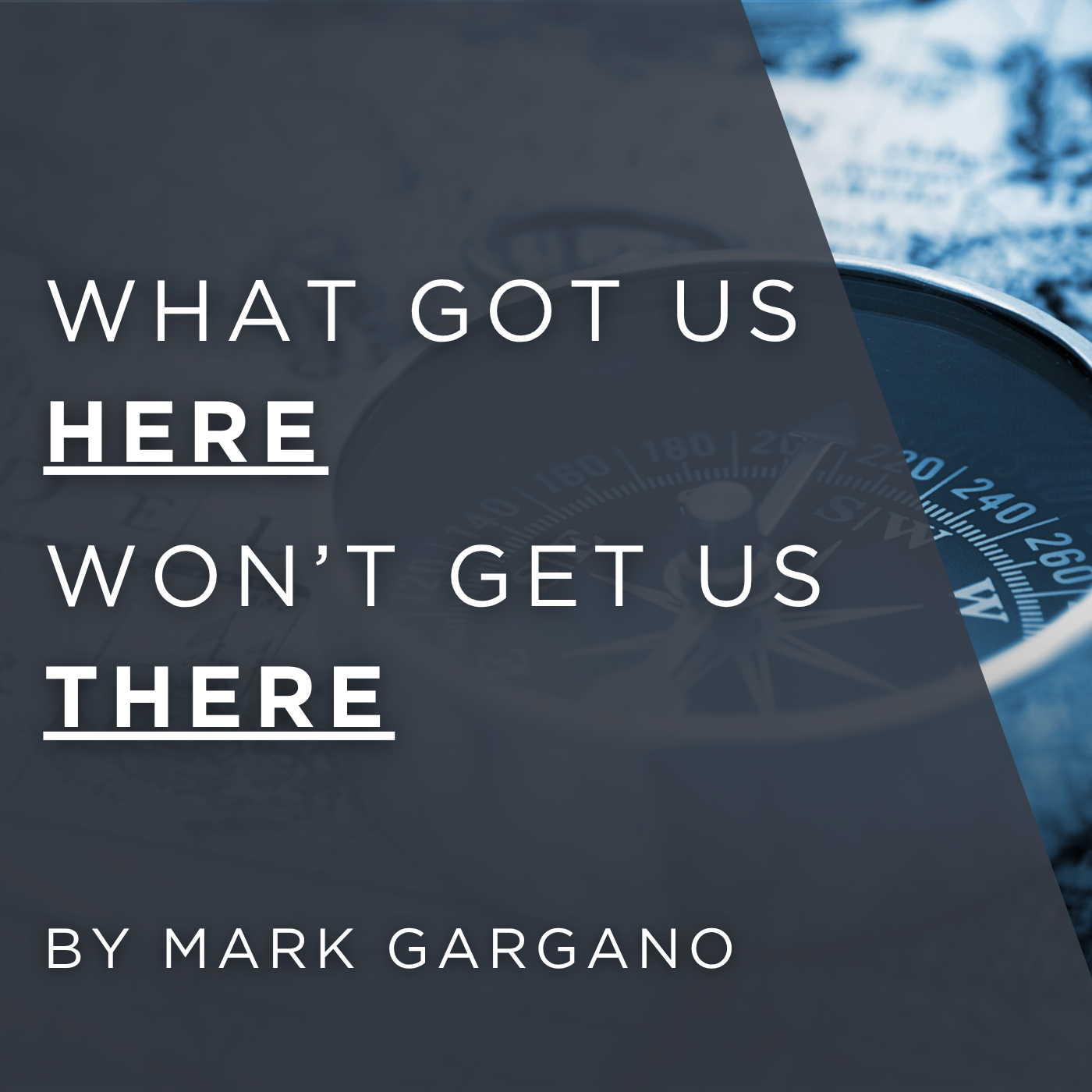
What Got Us Here. Won't Get Us There.
There’s a phrase that keeps coming back to me lately:
“What got us here won’t get us there.”
It sounds simple, almost obvious. But the more you sit with it, the more it feels like we’re living through one of those moments where that idea really matters.
Look around right now. Things are moving fast.
Artificial intelligence is accelerating. Technology is changing how we work. Medicine continues to evolve. Entire industries are being reshaped in real time.
None of this is happening in isolation either — it’s all colliding, overlapping, and pushing forward at the same time.
And yet, in a lot of areas, we’re still operating the same way we did decades ago.
Take education.
Most kids still learn in a structure that hasn’t changed all that much — classrooms, memorization, assignments, tests. And to be clear, learning how to learn is incredibly important. That part should stay.
But the environment around it has completely changed.
A child today has access to more information on a tablet than most universities had in their libraries not that long ago. And instead of leaning into that, we often treat those tools as distractions.
“Put the iPad away.”
“Stop watching YouTube.”
“Don’t play games.”
Sometimes that’s the right move. But I can’t help but think we might be missing something bigger.
What if the opportunity isn’t removing the tool, but learning how to use it differently?
The same device that delivers entertainment can also be a tool for learning, building, and discovering. The line between learning, play, and even work is starting to blur — and maybe that’s not a bad thing.
If you think about it, most of us don’t learn the way we used to either...
We’re not sitting in classrooms. We’re reading, listening, watching, trying things, making mistakes, adjusting. We pick things up in small moments throughout the day. We learn from people we’ve never met, in places we’ve never been.
We’re able to move faster, not because we’re smarter, but because the tools have changed.
And that changes everything.
It doesn’t mean the past was wrong. In fact, the systems that were built before us are exactly what made today possible. But it does mean that those same systems may not be enough for what’s coming next.
Industries are changing.
Careers are evolving.
Even medicine — one of the most established professions — is being reshaped by data, AI, and technology.
So the question isn’t whether things are changing. That’s obvious.
The question is how we respond to it.
How do we keep the wisdom of the past while adapting to the tools of the future?
How do we teach people — especially our kids — not just what to think, but how to think?
How do we build curiosity instead of just memorization?
I don’t have all the answers...
But I do believe this:
The most valuable skill over the next twenty years won’t be knowing everything.
It will be knowing how to learn.
Because the world our kids are stepping into is going to look very different from the one we grew up in.
And the systems that got us here… probably aren’t the ones that will take us where we’re going next.

Thank You For Reading
If you are a family or business owner reading this, consider three reflections:
Where am I spending time that doesn’t require my unique ability?
Where is money sitting without strategic direction?
Which relationships deserve more intentional investment?
The answers to those questions often reveal the path forward.
True wealth is not simply accumulation.
It is alignment.
Time aligned with purpose.
Money aligned with strategy.
Money aligned with strategy.
Relationships aligned with growth.
And when those are working together, 10x is no longer about scale alone — it is about significance.
Mark Anthony
Capital Compass and Key
Disclosure:
Investment advice offered through National Wealth Management Group, LLC, an SEC-Registered Investment Adviser.
All performance referenced is historical and is no guarantee of future results. All indices are unmanaged and may not be invested into directly.
The information presented is for educational and informational purposes only and is not intended as a recommendation or specific advice.
Additional Disclosure:
This material does not consider any investor’s specific objectives, financial situation, or particular needs and should not be construed as personalized advice. All investments involve risk, including the potential loss of principal. Strategies discussed may not be suitable for all investors and may change based on market, tax, or regulatory developments.
Before acting on any information contained herein, individuals should consult with a qualified financial, legal, or tax professional who can assess their unique circumstances.